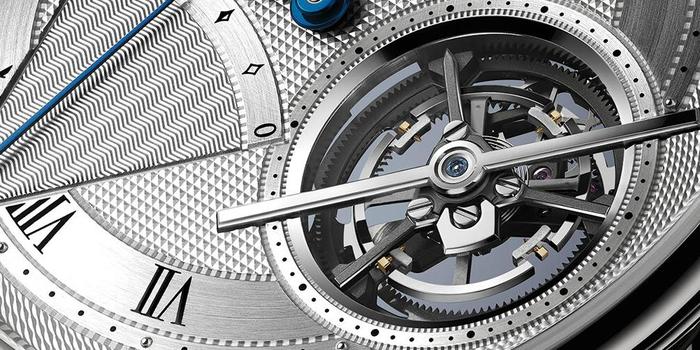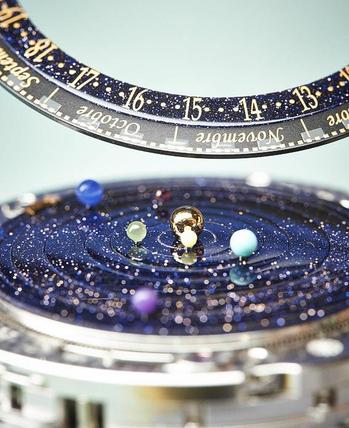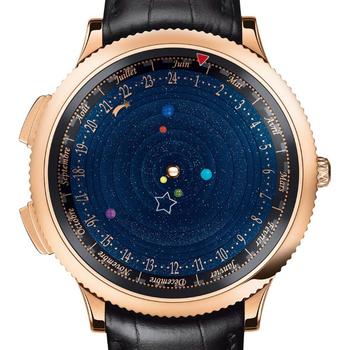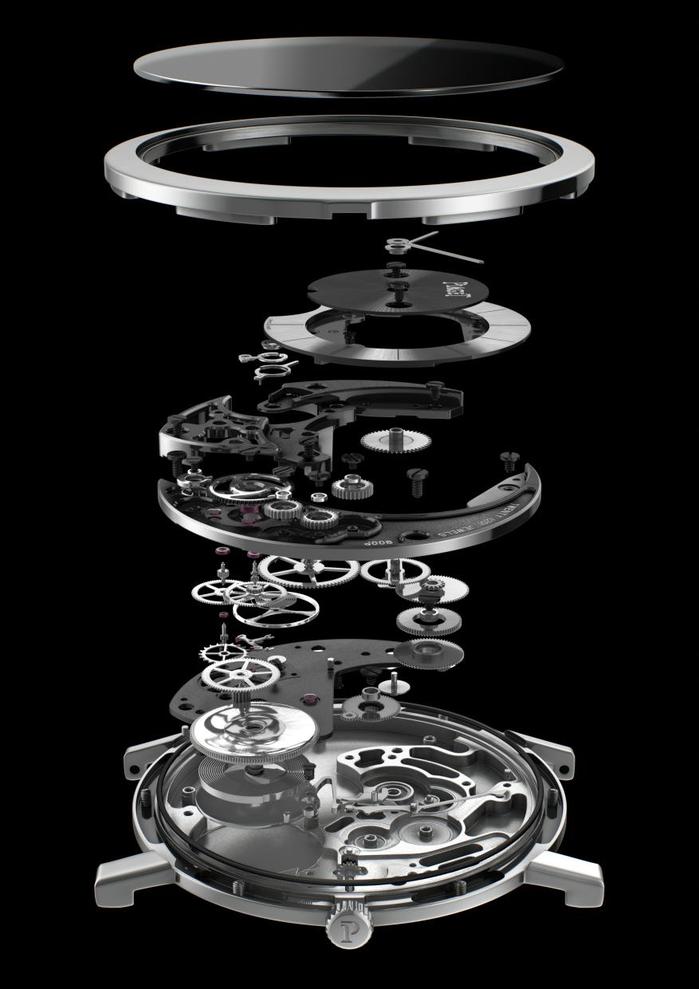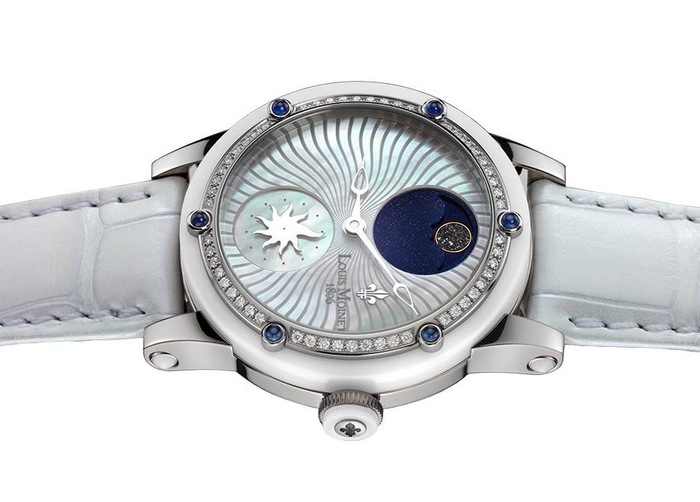
Closeup shot of the dial
(source)
A closeup of the massively complex RMCC1 movement. It has a split-second chronograph, a tourbillon, both torque and power-reseve indicators as well as RM's unusual push-button mode control.
(source)
A

The first of three high-end watches released by Richard Mille (previously mentioned), this one is based on their standard tourbillon movement, as seen in the production RM002 and several of their limited editions. The skull (apparently they got the Damien Hirst memo 2 years late, maybe they'll have a spots piece in a year or 2), isn't an overlay on the movment, but the actual plate of the watch, with the pivot of the tourbillon cage clasped in his teeth.
At an angle you can really see the depth of the case, 15 will be sold in Titanium and 6 more in either rose or white gold.
Even the top plate, seen through the back of the watch is skull shaped, though in this case more like the bottom of a skull then the iconic "face".
(source)
A
Vacheron (previously mentioned) released a M.C. Escheresque watch for the 2011 Only Watch auction, and has now released 3 more as members of their Métiers d'Art collection, Les Univers Infinis. Well 2.5 more, the Dove design is the Only Watch dial with different colors of enamel.
The cases are all 40mm 18kt white gold and all are powered by Vacheron's workhorse cal. 2460. All three dials are engine-worked under enamel. In addition the dove dial is set with small diamonds for one of the birds and the seashells have a hand-envraved overlay.
| Doves |
|---|
| Fishes |
| Shells |
A
Though not the first Mayan-Apocalypse(if you insist) themed watch, the recent release from DeBethune (previously mentioned)sets an extremely high bar for the rest of the competition, as one might have expected. The 12-piece edition has a solid gold dial hand-engraved by Michèle Rothen and inlaid with the 31 flame-blued steel bits which form the numerals. The chapter ring displays the numerals of Mayan numbering system with the inner ring showing the 20 glyphs of divinities, animals and sacred objects representing the various days of the calendar. 2012 represents the end of the "Long Count" sequence, and the center of the dial depicts the baktun, a glyph for a time-period, and used in particular for calculating the "Long Count" and comprising 144,000 days.
The hands are made with one of DeBethune's unusual techniques, blued-steel wrapped around sapphire centers. Power comes from a DB Cal. 2005, a 6-day manual-wound movement with 29 jewels and the case is 18k white gold.
A
Geneva's Musée d'Art et d'Histoire as opened a new special exhibit "Watchmaking in Geneva. The Magic of Craftsmanship, Treasures of Gold and Enamel", from December 15th 2011 to April 29th 2012. One of the sponsers was Vacheron Constantine and they're running a concurrent smaller exhibit, "Watches with special displays... various ways of telling the time" from December 15th 2011 to January 22nd 2012.
One of the more interesting pieces from this exhibit is a early 20th century piece using the Bras en l'air method, where the arms of the figure lift to point to the current time when the button on top is pressed. This one, in particular is both an excellent example of that complication and the quaint, pervasive racism of the time.
(source)
A
One of the more recognizable pocket-watches in the Musée d'Horlogerie in Le Locle is an oval piece by Vardon & Stedmann, a pair of British watchmakers from approx 1800. Driven by a cam hidden above the center pinion, the hands expand and contract to follow the outline of the case.

This piece is on a long-term loan to the musuem from the Sandoz Family, which conviniently owns the Parmigiani watch brand, who've produced a modern rendition of the piece, the bluntly named "Toric Ovale with Telescopic Hands". Limited to 30 pieces in white gold and 30 more in rose gold, this massive (52mmx37mm) watch uses flame-blued steel for the hands over a Grand Fue enamel dial, with apertures for the date and RdM (power reserve) of the 8-day, manually-wound movement. MSRP will be $95,000
(main source, antique watch source)
A
If everybody else has too much sense!
219 (the actual name of the brand) has released the Kukulcan GMT, a watch 'celebrating' the end of the Mayan calendar cycle in 2012.
The 47mm white-gold case is set with 36 baguette-cut Colombian emeralds and powered by a Valgranges GMT movement (it's a VJ 7750 with a bigger plate). The back of the case has a hand-engraved image of part of the Mayan calendar surrounding what the press release calls the "Death God" (no indication which of the numerous deities they are actually referring to, assuming they even know). The outer chapter ring of the dial indicates the hours 1-12 in Mayan numerals and the face of Kukulcan, a feathered serpent, staring directly at the wearer
(source)
A
More pre-SIHH watches from Cartier with silly long names(see the Rotonde Minute Repeater Flying Tourbillon), this time the "Grand Complication Skeleton Pocket Watch", which is exactly what it sounds like. Despite the press release referring to the movement as a "manual-wind Cartier in-house caliber 9436 MC with 37 jewels, 21,600 vph and a power reserve of 8 days", it is the same Renaud et Papi caliber they use for some grand-complication each year, this time as a pocketwatch. The real artistry from Cartier is in the white gold case, which has the skeletonized roman numerals attaching the movement to the edge, even hiding the correctors for the QP. The numerals are in the clear Cartier serif font, and really well finished (see live pics from SJX over at thePurists). The sides of the case are a nicely executed chevron pattern and the crown/pusher for the chrono is the current Cartier standard, with beads and a blue sapphire cabochon on top.
| Dial side of the watch | Pocketwatch with the included 18kt white-gold chain |
|---|---|
At 59mm in diameter and a full 1/4 lb, it's not going to be an easy piece to carry, so Cartier includes a desk stand of rock crystal on an onyx base. The design is somewhat of an homage to their Mystery Clocks(see previous post) from the beginning of the 20th century.
(source)
A
More pictures from Torsten Nagengast of the Knesebeck triple-tourbillon desk clock(earlier reference), showing the growing tourbillon mechanism and the horizontal time display.
(source)
A